Planting design is a challenging and fun part of garden design. There are many different approaches to planting design, and there is no right or wrong way to do it. A simple approach includes buying plants that you like and installing them where they fit. There is nothing wrong with methods like this, but this approach here is more systematic. First, clarify the purpose of the plants you are trying to use, and then create a planting plan of plant types, starting with large structural plants and working down to smaller ones. The final step is to select specific plants for the design.
Plant Purpose
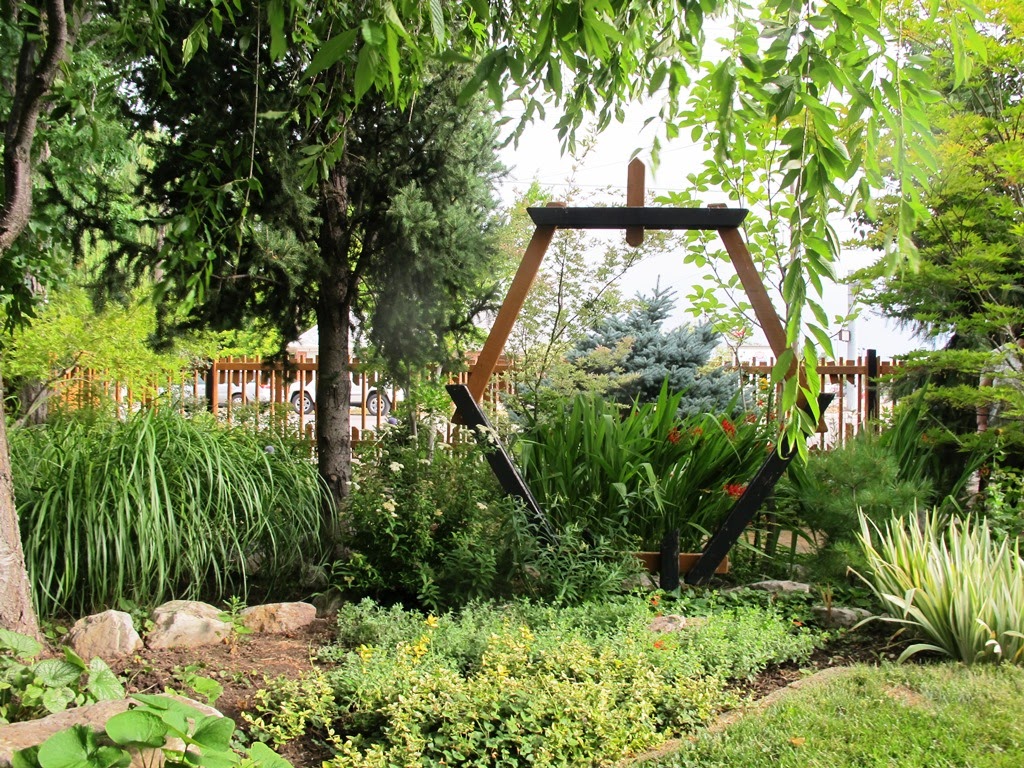
Plants serve five primary purposes in the garden:
- Production: Plants produce tangible products, like food.
- Function: A plant performs a functional value, like a shade tree.
- Aesthetics: Plants are pretty and grown for their aesthetic qualities, like flowers.
- Fillers: Plants are used to cover space, like groundcovers.
- Environment: Plants contribute to the healthy ecosystem of the surrounding region, like native and pollinator plants.
Production
Productive plants can be vegetables, fruits, herbs, cut flowers, seeds, or trees for firewood. Selecting a plant for production purposes is fairly straightforward. You want a tomato, so you plant a tomato. Be sure to look at varieties that have the characteristics you want and can adapt to different situations, as discussed later. There are times, however, when you desire a plant but find that you simply do not have the right environment for it. Blueberries might taste great, but they are rarely worth the high input and risk of growing in alkaline (high pH) soil. Many times, the best course of action is to find a replacement that will do well in the environment you have.
Function
A functional plant is one that performs a purpose in the landscape. Common plant functions include:
- Shade: trees, vines, large shrubs
- Screening: hedges, trees, vines
- Framing: trees, large shrubs
- Play/entertainment: lawn
- Traffic: lawn, walkable groundcovers
- Drainage: rain gardens
- Erosion: grasses, groundcovers, shrubs
- Wind break: trees, hedges
There are usually a variety of plants that can perform the desired function. Take environmental preferences and aesthetics into consideration to pick the best plant for function. Also consider time to maturity. An oak might make a great shade tree, but you might not want to wait the fifteen years from planting until the time it is large enough to give shade.
Aesthetics
Planting for aesthetics includes plants like flowers, annuals, perennials, ornamental grasses, shrubs, and small trees. The primary purpose is to provide beauty. There are many characteristics that are considered when selecting a plant for aesthetics, such as bloom timing and color, which will be discussed in more detail under plant selection.
Fillers
Filler plants can include shrubs, groundcovers, and grasses. Filler plants are used when an area needs to be effectively covered. Too much bare soil is not only unsightly, but can invite undesirable pests like weeds. Many areas of our landscape are not needed for productive or functional purposes, but are also not worth the effort or funds required to create a colorful, aesthetic garden. Lawn is often used extensively as a filler plant. Lawn can be a decent filler, but many lawns require significant inputs, and it creates a monoculture with limited environmental benefits. Many groundcovers, shrubs, and other plants can fill space, look better than a lawn, provide increased environmental benefits, and require little to no inputs.
Environment
Plants can contribute to the local ecosystem and environment. Plants picked specifically for this purpose can build soil, help pollinators, provide wildlife habitat, clean air and water, conserve resources, and provide biodiversity, especially by including native plants. One of the best ways to accomplish this is to model your plant groups after native communities found in your local ecoregion. Native plants are often the most beneficial, but other plants can also provide support to the environment.
Multipurpose
Ideally, each individual plant serves multiple purposes. Although plants are often separated by purpose, integration can be functional, beautiful, and healthy. For smaller gardens, use multifunction plants and intermix plants rather than grouping by use.
Plant Types
The following categories typify most plants.
- Shade Trees: Woody plants that can grow from one stem or trunk.
- Use: function, aesthetics
- Conifer Trees: Trees that are usually evergreen and have needles.
- Use: function, fillers, aesthetics
- Small Trees: Woody plants from one or more stems.
- Use: production, aesthetics, function
- Shrubs: Woody plants, below 15 feet, with multiple stems.
- Use: production, fillers, function, aesthetics
- Evergreen Shrubs: Shrubs that maintain their leaves year-round.
- Use: aesthetics, fillers, function
- Subshrub: A small shrub or large perennial that provides structure.
- Use: production, aesthetics, function, fillers
- Ornamental Grasses: A grass that is not mowed.
- Use: fillers, aesthetics
- Perennials: Herbaceous (non-woody) plants that last 3+ years.
- Use: aesthetics, production, fillers
- Lawn: Turf grass and other species that are mowed.
- Use: function, fillers, aesthetics
- Groundcovers: Plants that cover wide areas and are low-growing.
- Use: fillers, function, aesthetics
- Vines: Plants that climb up a support
- Use: production, function, aesthetics
- Annuals: Plants that last for one year, although some may self-seed.
- Use: production, aesthetics
- Specialty plants: Other plants like succulents, cacti, and tropical plants.
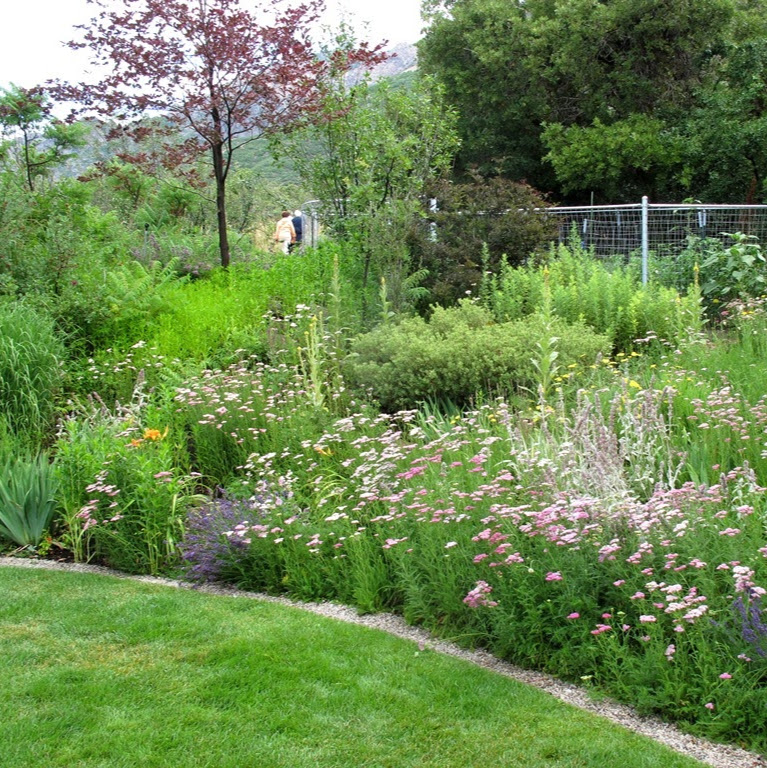
Plants are generally not grown in monocultures, but in mixed beds. A mixed bed is any combination of annuals, perennials, shrubs, trees, and groundcovers. Lawns are grown separately and need to be separated by a physical barrier. The following are some common combinations of plants:
Kitchen Gardens: Focus primarily on productive plants with vegetables, herbs, cut flowers, and fruits. Usually includes a smattering of plants for aesthetics.
Food Forests: Primary focus on productive plants, with a focus on perennial and woody species. It also incorporates support species that help the environment.
The following plant combinations are often created to mimic native ecosystems and provide environmental benefits.
Meadows: A combination of grasses and perennials.
Shrublands: Dominated by shrubs, with a mix of perennials, grasses, groundcovers, and an occasional tree.
Woodlands: Scattered trees, with a wide range of additional plants like shrubs, perennials, and groundcovers.
Forests: Dense trees with groundcovers.
Designing
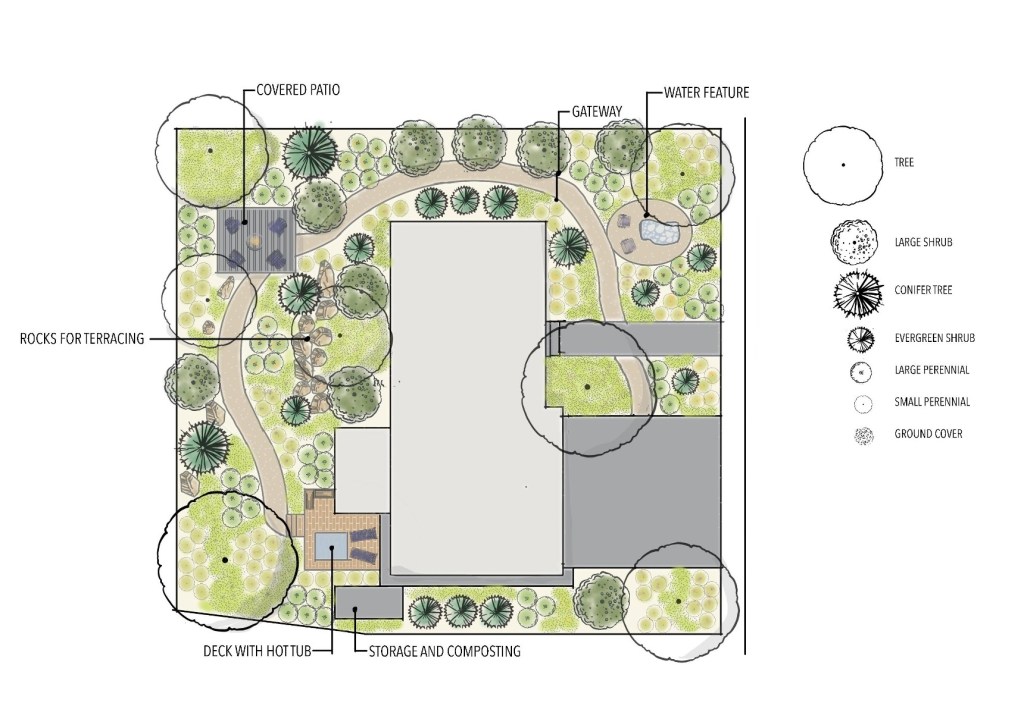
Keep in mind the purpose of each plant and the type of combination you want in an area, and then start specifying plant types. Start with larger structural plants (trees), and work downward on the list of plant types. Plants naturally grow in overlapping layers, for example, a canopy of trees, an understory of shrubs and perennials, and a groundcover layer of grasses and herbaceous plants. Allow for this on your planting plan.
Start by specifying plant types instead of specific species. This allows for future adaptation. For example, you might want a dwarf lilac, but cannot find one in stock locally. If you specify only a small flowering shrub, you can easily swap it out for a different plant.
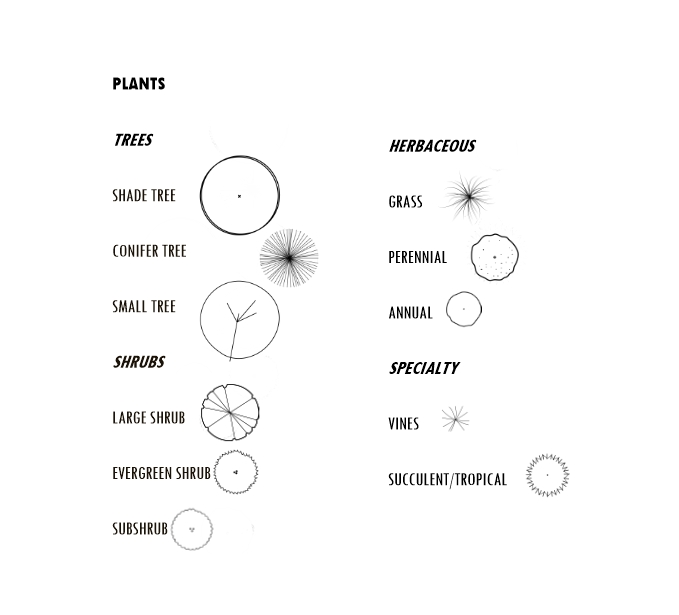
Each plant type can be displayed with a specific plant symbol. Here are some suggested symbols:
Size
The size of a plant will change from initial planting to maturity. You need to plan for the eventual mature size of the plant to ensure proper spacing. The plant width is usually the first factor thought of when designing, but the height is just as important. Height varies with the age or season of growth. Woody plants maintain their height year-round, with increased size in the growing season, unless there is dieback or pruning. Herbaceous plants can die back to the ground in the dormant season, and the size of the plant will grow as the season progresses.
Specifying a size beforehand also helps you pick a plant. For example, if you want a small tree in a side yard, you might find that the canopy needs to be less than 15′. This narrows down your tree selection, and you are better able to pick a plant that meets the requirements of the site. Here are some general rules of plant sizes you can use while designing.
| Plant Type | Width Range | Height Range |
| Shade Trees | 20-50+ ft | 15-50+ ft |
| Conifer Tree | 5-40 ft | 8-50+ ft |
| Small Tree | 5-30 ft | 10-30 ft |
| Shrubs | 4-15 ft | 3-15 ft |
| Evergreen Shrubs | 2-15 ft | 1-15 ft |
| Sub-Shrub | 3-6 ft | 3-8 ft |
| Ornamental Grass | 1-6 ft | 1-8 ft |
| Perennials | 1-5 ft | 1-6 ft |
| Groundcover | 1-6 ft | 1-12 in |
After you pick a specific species of plant, there is often some modification needed to the planting plan. For example, there might be a grouping of groundcovers. Originally, there were 12 plants covering an area of 48 square feet, spaced at two feet (each plant takes 4 square feet). The groundcover you want grows to four feet wide (taking 16 square feet). You modify the design to include 3 plants instead of the original 12, which will cover the same square footage.
Even carefully designed plans still often need further modification. The mature size of plants can vary depending on other conditions, like water availability, climate, and the care it receives. Planting plans often have to be modified over time to accommodate unanticipated changes. This should be looked at as an opportunity to work with the site. Changes over time can result in unexpected, beautiful gardens.
A successful planting design uses plant types arranged in intentional combinations so that plants can fulfil their purposes in the garden. While gardens evolve over time, starting with a thoughtful framework gives the garden a good start.
 Responsive Gardens