I recently graduated with a degree in instructional design. (How I ended up with that degree when I’m primarily a landscape designer is a long story for another time.) Here are the important things I learned. This started as an essay written for a school assignment, so forgive the stuffy tone.
What is Important to Learn
Although learning is often focused on the gain of factual information, learning should instead focus on developing skills that will aid the learner in a variety of circumstances. This includes the ability for learners to engage in just-in-time learning when new problems arise. They also develop the ability to research and disseminate good information. Learners need to develop critical thinking and be able to solve a wide variety of problems.
Learning should also be focused more on learning of things, instead of about things. This is mainly achieved by learning by doing and having a more immersive learning experience. Learners need to learn to collaborate with others and learn how to produce something: for example, a project or framework of ideas. This production includes the first formation of ideas and the learner should be able to learn how to carry this through to completion and resolution.
Define Outcome & Create Effective Objectives
Often termed backward design, good instruction starts with defining the outcome. When designing instruction, don’t start with what information needs to be learned, or what activities are going to be done, but what learners are supposed to be able to accomplish effectively when they complete the instruction. These create actional objectives that then lead to the development of activities and information taught in the class.
Learner-Centered
Learning should be focused on the needs and desires of the learner, and they should have control of their learning experience. Learners need to develop life-long learning: knowledge and skills need to continue to grow to be successful. Life-long learning happens as learners have access to a variety of readily available resources that can aid them in their learning pursuits. They also benefit from guidance from others, from those who are more skilled than themselves.
How Learning Occurs
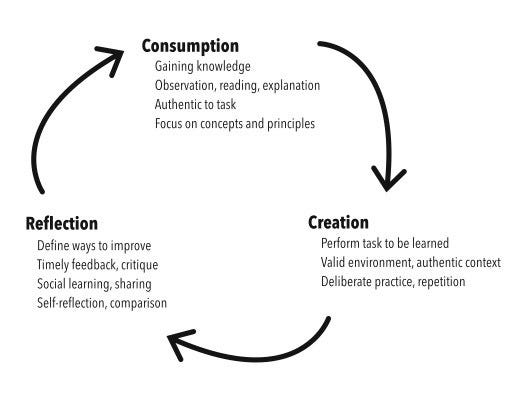
Learning starts with the introduction of knowledge, including facts and ideas developed by others. Learners transform this information into their own ideas and then produce those ideas in some tangible form. They learn to reflect on their ideas and products, which leads to greater refinement. Learning is a balance of consumption and creation. Consumption occurs in the obtainment of more knowledge from others, and creation allows the continued development of the knowledge where learners make it their own.
Learning is centered on real-world problems and creative solutions. Interaction is a core component. Learners learn to converse about their work, developing the ability for reflection-in-action, and they share their work share with others. They engage in additive group work, where their work is part of a larger whole. In this way, the work they do matters beyond the traditional concept of grades and degrees.
Creation
Learning ideally happens in a valid environment mirroring real-world situations to increase the ability to transfer learning from the learning experience to ongoing use. In this authentic context, learners try to perform, create, or do the defined learning task. This experience is ongoing and refined with deliberate practice and repetition. Learning challenges provide learners the opportunity to explore what they know and apply it.
Reflection
Simply performing a task repeatedly does not ensure that improvement comes. Instead, learners need to reflect on what they are doing and define ways to improve it. This occurs partially through self-reflection, but more importantly through social learning. They gain valuable feedback from sharing with others, especially those who are more experienced. Learners should understand the consequences of the output of their creation. Timely feedback provides critique and evaluation that allows the learner to improve.
Consumption
This step is often thought of as what learning is: it occurs through gaining new knowledge, through observation, reading, and explanation. Gaining knowledge is essential but must be part of an ongoing cycle to be effective at obtaining the learning objectives. Consumption must be based on authentic learning: the facts, procedures, and concepts learned should mirror what needs to be created and shape the reflection of learners. What is learned should also be focused on broad concepts, first principles, and other information that applies to learners in a wide range of circumstances, rather than focusing too much on specific details.
Respond to Evaluation
Course design does not need to be bulky, and unchanging. Rather, design should be ongoing and respond to feedback and evaluation. The successive approximation model (SAM) demonstrates this idea. It follows principles similar to agile project management: course design is done in short cycles that allow for ongoing evaluation, and the quick implementation of feedback. It is more critical to engage in iterative development rather than try to create perfect content from the get-go.
Just…Good
Instruction need not be boring, overdone, or difficult. It can follow the principles of good pedagogy. Good instruction is meaningful, memorable, and motivational (Michael Allen). It uses a variety of methods, interleaves information to allow for cognitive learning, and follows other principles outlined here. If you are bored by the content you are designing, then certainly the learners will be too. That doesn’t mean learning material needs to be flashy: rather the importance should be focused on quality learning experiences.
Resources
Michael Allen’s Guide to e-Learning: Building Interactive, Fun, and Effective Learning Programs for Any Company by Michael Allen
Leaving ADDIE for SAM: An Agile Model for Developing the Best Learning Experiences by Micael Allen with Richard Sites
Veritasium: The 4 things it takes to be an expert
Teaching in a Digital Age by A.W. Bates
Understanding by Design by Grant Wiggins and Jay McTighe
Make it Stick by Henry L. Roediger III, Mark A. McDaniel, and Peter C Brown
 Responsive Gardens